Figure 9 — Long-series generators (Diffusion-TS, Chronos, TimesFM, Timestral)
File: fig09_long_generators.pdf
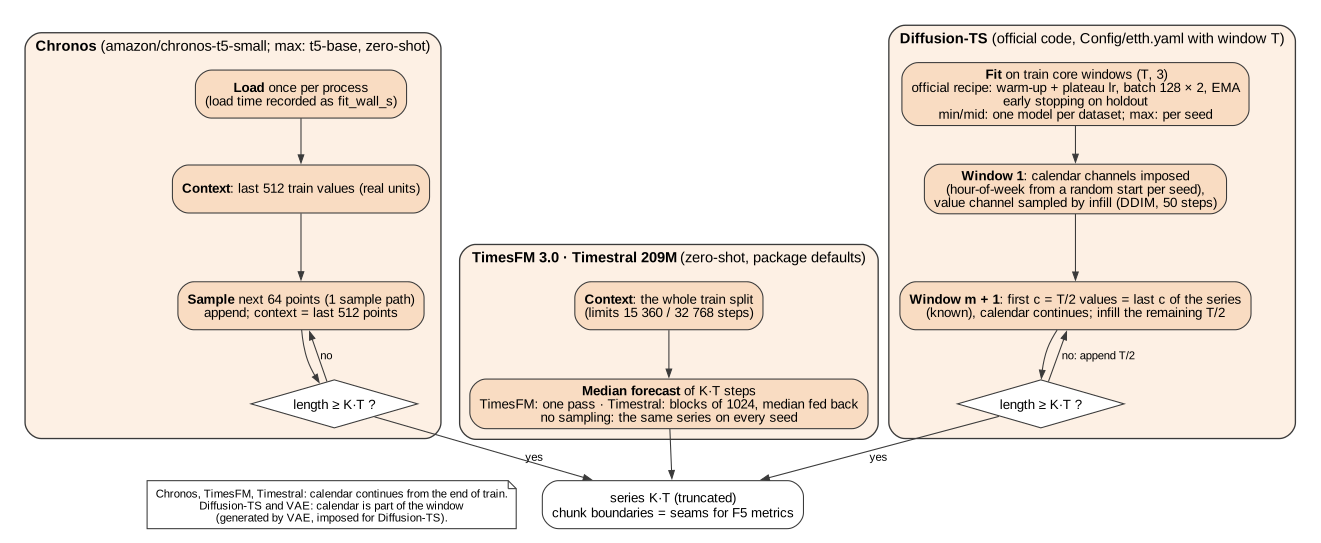
Suggested caption. The baselines that generate long series directly. Diffusion-TS grows the series by autoregressive infilling: each new window takes the last T/2 generated values as known context and fills in the rest. Chronos samples continuations of the end of the training series in chunks of 64 points. TimesFM and Timestral give their median forecast of the K·T steps after train, with the whole train as context (up to the model's limit). Boundaries between chunks or blocks count as seams in the seam metrics.
Diffusion-TS
- Official implementation (
external/Diffusion-TS, pinned commit), hyperparameters fromConfig/etth.yamlwith window length T. - Trained on the same core windows as the VAE, with an exponential moving average (EMA) of the weights; optimiser, learning-rate schedule (warm-up to 8e-4, then plateau decay), batch 128 with gradient accumulation 2 and EMA as in the official solver; early stopping on the holdout windows.
min/mid: one model per dataset;max: one model per seed.- Generation: the calendar channels are known at every position (hour of week continues from a
random start, one per seed); only the value channel is generated. Window 1 is generated with no
known values. Each later window takes the last c = T/2 values as known context and infills the
remaining T/2 (
fast_sample_infill, 50 DDIM steps). The result is truncated to K·T.
Chronos
amazon/chronos-t5-small(max:chronos-t5-base), no fine-tuning. Loaded once per process; the load time is recorded asfit_wall_s.- Context: the last 512 real training values. The model samples one path 64 points at a time; each chunk is appended and the context is cut back to the last 512 points.
- The hour of week continues from the end of train.
TimesFM 3.0 and Timestral 209M
- Pretrained forecasters used zero-shot as documented, package defaults, revisions pinned:
google/timesfm-3.0-pytorch(packagetimesfm3.0.2) andmistralai/Timestral-209M(packagetimestral). - Context: the whole training split (within 15 360 and 32 768 steps). The series is the median forecast of the K·T steps after train: TimesFM in one non-autoregressive pass (no seams), Timestral in blocks of 1024 steps with each block's median fed back (block boundaries are seams).
- No sampling: the series is the same on every seed, so its between-seed spread is zero.
- Leakage: Chronos is left out on
electricityandbeijing_pm25, TimesFM onhousehold,beijing_pm25andbitcoin(the same data or object in their training data, DATASETS.md); Timestral is pretrained on synthetic data only, and the real data of its post-training are not listed, so its pairs are unknown and kept (DATASETS.md).
Notes for the text
- Calendar handling differs across families. The VAE generates the calendar channels as part of the window, Diffusion-TS has them imposed, and Chronos, TimesFM and Timestral continue the real calendar. For this reason the calendar-continuity metrics F4.4–F4.5 are left out of the ranking and the cross-family comparisons (RQ1–RQ3, CS9).
- Cost: for the longest dataset (PJM, profile
max), Diffusion-TS needs about 1 000 sequential infills of 50 DDIM steps per seed.