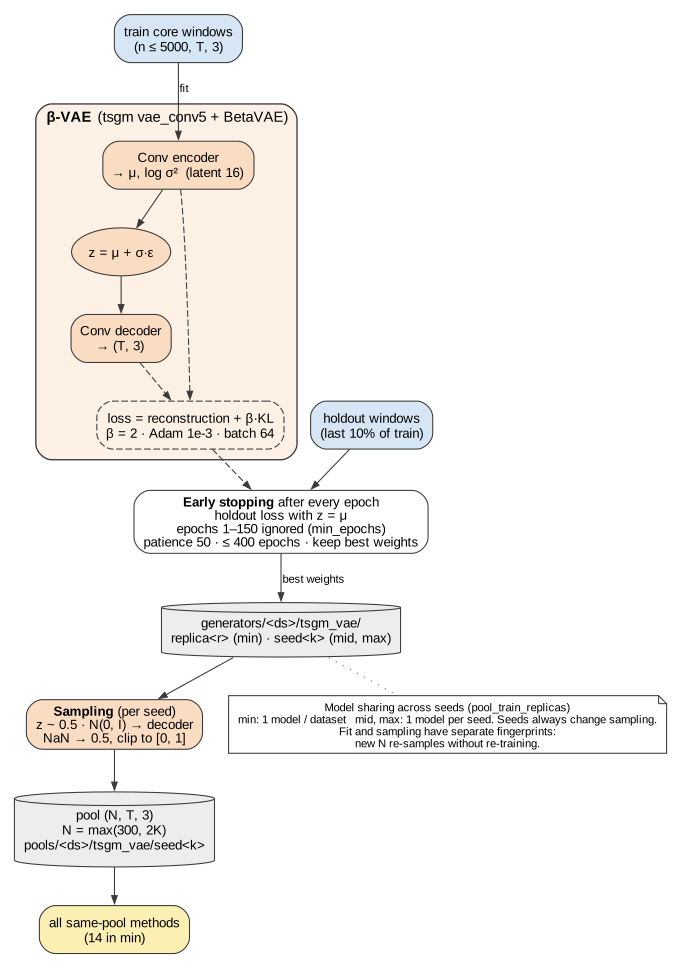
Figure 6 — Pool generator (β-VAE)
File: fig06_pool_generator_vae.pdf
Suggested caption. The window-pool generator. A convolutional β-VAE is trained on core training windows and stopped early on the holdout loss. After training, N windows are sampled from a shrunk prior and written to disk as the pool that every same-pool method shares.
Details
| Item | Value |
|---|---|
| Architecture | tsgm vae_conv5 encoder/decoder + BetaVAE, latent dimension 16 |
| Loss | reconstruction + β·KL, β = 2 |
| Optimisation | Adam, lr 1e-3, batch 64, up to 400 epochs |
| Early stopping | holdout loss after each epoch with z = μ; patience 50; best weights restored; epochs 1–150 are not eligible (vae_min_epochs; taken from earlier work of the authors on other data) |
| Sampling | z ~ 0.5 · N(0, I) → decoder → NaN replaced by 0.5 → clipped to [0, 1] |
| Pool | N = max(300, 2K) windows of shape (T, 3), per (dataset, seed) |
Model sharing across seeds (pool_train_replicas)
min: one VAE per dataset (9 trainings in total); seeds change only the sampling.mid,max: one VAE per seed (90).- Any other value k of
pool_train_replicasgives k VAEs per dataset; seed s uses model s mod k.
The training time of a shared model is recorded for every seed and enters the cost comparison (RQ6) for each of them.
Notes for the text
- The assembler does not depend on where the pool comes from. Any generator that outputs windows in
the same three channels can replace the VAE (registry
pool_generators; e.g.sdv_par,real_windows). - Fitting and sampling have separate fingerprints. Changing N re-samples the pools from the saved weights without retraining the VAE.