Figure 8 — The compared methods
File: fig08_method_family.pdf
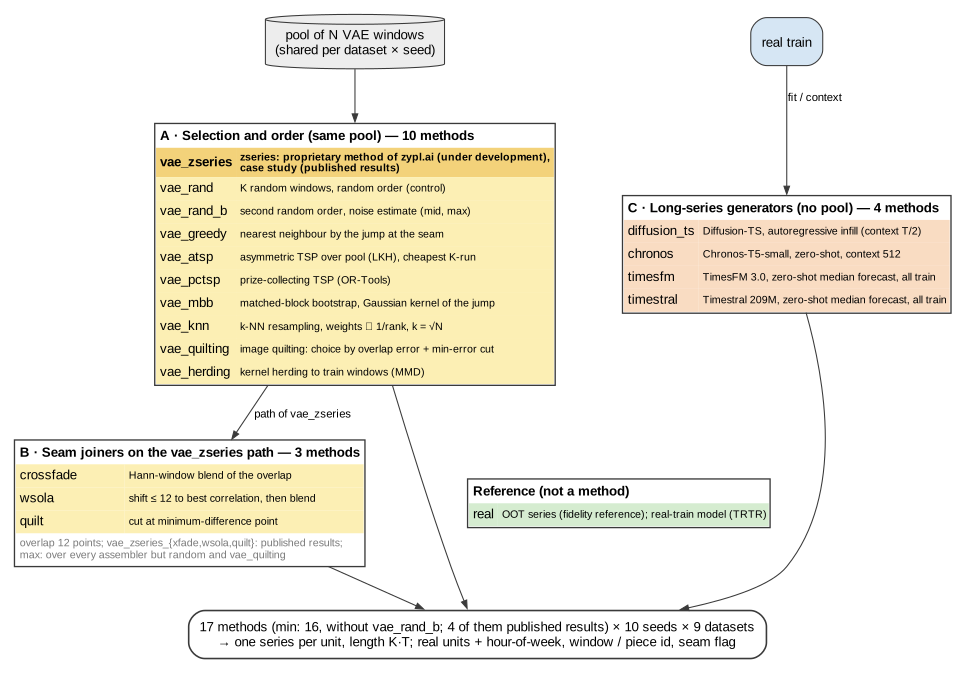
Suggested caption. The compared methods. Groups A and B take windows from the same VAE pool, so they differ only in which windows they pick, in what order, and how seams are handled. Group C generates long series directly. Every method returns one series of length K·T per (dataset, seed).
Groups
A — Selection and order (10 methods in mid / max, 9 in min without vae_rand_b; same pool).
vae_zseries (zseries, the proprietary assembler of zypl.ai (under development), the case-study method: its results are published
(Config.frozen_methods), its code is not part of the repository); the
control vae_rand (K random windows in random order) and, in mid and max, vae_rand_b (a second
independent random order, used to estimate noise); alternative assemblers, each with the seam criterion
of its own literature: vae_greedy (nearest neighbour by the jump at the seam), vae_atsp (asymmetric
TSP over the whole pool with LKH via elkai; the cheapest run of K consecutive windows in the tour),
vae_pctsp (prize-collecting TSP in OR-Tools: chooses K of N windows and their order at once; up to
2 000 solutions or 60 s) — the three solvers by the jump at the seam, the Euclidean distance between the
last point of a window and the first point of the next (the frame distance of video textures);
vae_mbb (matched-block bootstrap: a Gaussian kernel of the jump, bandwidth = median jump), vae_knn
(k-nearest-neighbour resampling, k = √N, weights ∝ 1/rank), vae_quilting (image quilting: a random
window among those whose overlap error is within 1.1 × the best, then the minimum-error cut),
vae_herding (kernel herding towards train windows under MMD; random order).
B — Seam joiners (3 methods; 21 in max). Applied to the path of vae_zseries (published results; in max
also to every assembler except the random path and vae_quilting). Neighbouring windows overlap by 12 points: xfade blends the overlap with a
Hann window, wsola first shifts the next window by up to 12 points to the best correlation, and
quilt cuts at the point of minimum difference (1-D image quilting). Overlap shortens the series, so
the joiner takes more windows than K and truncates the result to K·T.
C — Long-series generators (4 methods). diffusion_ts (Diffusion-TS trained on the same
training windows; series grown by autoregressive infilling), chronos (pretrained Chronos-T5-small,
zero-shot, sampled), timesfm (TimesFM 3.0) and timestral (Timestral 209M): pretrained forecasters
used zero-shot as documented — the median forecast of the K·T steps after train, the whole train as
context (up to the model's limit), the same series on every seed. See Fig. 9.
Reference. real is not a method: in fidelity it is the OOT series (real-versus-real reference); in utility it
is the model trained on real train (TRTR).
Notes for the text
- Scale: 16 methods in
min(withoutvae_rand_b), 17 inmid, 35 inmax, of them 4 published results (vae_zseriesand its three joiner variants); the pipeline runs 12 / 13 / 31 methods × 10 seeds × 9 datasets = 1 080 / 1 170 / 2 790 generated series. - Every series is stored with its hour of week, the source window and piece of each point, and a seam flag. The seam metrics (F5) use the flag; for group C, chunk boundaries count as seams.
- Source:
marathonts/bench/methods.py,marathonts/bench/assemblers.py,marathonts/bench/joiners.py,BASELINES.md.