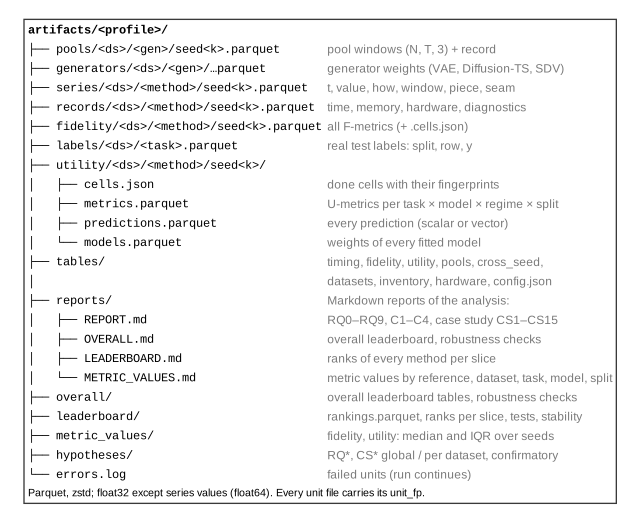
Figure 16 — Artifact layout
File: fig16_artifact_layout.pdf
Suggested caption. Layout of the benchmark outputs. Every unit of work writes its own Parquet
file. The collect stage merges them into the published tables in tables/.
Contents
| Path | Row / content |
|---|---|
pools/<ds>/<gen>/seed<k>.parquet |
pool windows (N, T, 3); .record holds training and sampling time and diagnostics |
generators/<ds>/<gen>/… |
generator weights (VAE, Diffusion-TS, SDV, plugins) |
series/<ds>/<method>/seed<k>.parquet |
generated series: t, value, hour of week, window, piece, seam flag |
records/… |
time, memory, hardware and diagnostics of each generation run |
fidelity/… |
one row with all F-metrics |
labels/<ds>/<task>.parquet |
real test labels (split, row, y) |
utility/<ds>/<method>/seed<k>/ |
metrics, every prediction, weights of every fitted model, cells.json (done cells) |
tables/ |
timing, fidelity, utility, pools, cross_seed, datasets, inventory, hardware, config.json |
reports/ |
Markdown reports of the analysis: REPORT.md (research questions RQ0–RQ9, confirmatory family C1–C4, case study CS1–CS15), OVERALL.md (overall leaderboard), LEADERBOARD.md (ranking of every method in every slice), METRIC_VALUES.md (values of the core fidelity metrics and the primary utility metrics by reference, dataset, task, model and split) |
overall/ |
tables of the overall leaderboard (fidelity on the core metrics and utility, noise-aware ranks) and its robustness checks |
leaderboard/ |
tables of the ranking of every method in every slice, incl. rankings.parquet (the four rankings) and rankings_summary.parquet |
metric_values/ |
fidelity.parquet, utility.parquet: median and IQR over seeds of every metric × reference and task × model × split, per dataset and method |
hypotheses/ |
per-question global and per-dataset tables (RQ, CS), confirmatory family |
errors.log |
failed units (the run continues) |
Notes for the text
- Storage: Parquet with zstd; float32 everywhere except series values (float64). Each profile
writes to its own
artifacts/<profile>/. - Every model and generator can be reloaded and used without retraining (
marathonts/bench/load.py), so reviewers can re-evaluate saved models on new test data.