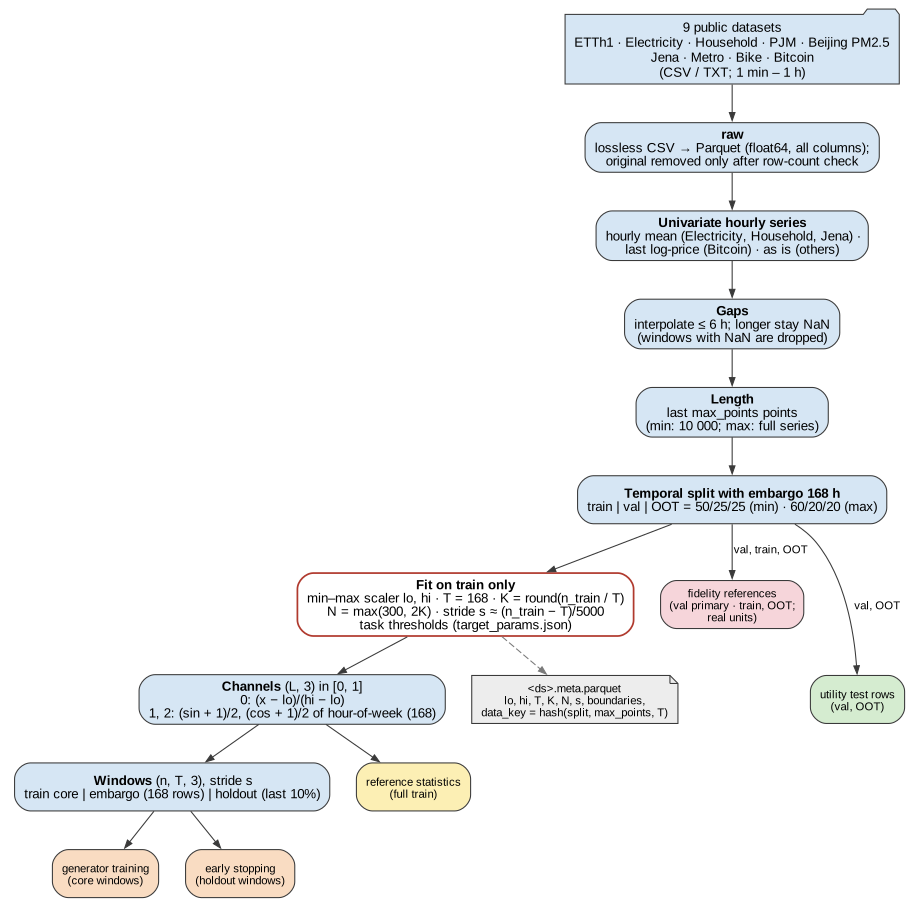
Figure 4 — Data preprocessing
File: fig04_data_preprocessing.pdf
Suggested caption. From raw files to model inputs. Each dataset becomes one hourly univariate series. The series is split in time with embargoes. All statistics (scaler, window length, number of windows, task thresholds) are fitted on the training split only. The series is then encoded as three channels in [0, 1] and cut into windows (red box: the leakage boundary).
Steps
- Sources. Nine public hourly-or-finer datasets: ETTh1, Electricity Load Diagrams, Household
Power, PJM (PJME), Beijing PM2.5, Jena Climate, Metro Traffic, Bike Sharing, Bitcoin
(
DATASETS.md). - raw. Lossless conversion to Parquet (float64, all columns). The original file is removed only after the row count matches.
- Hourly univariate series. Hourly mean (Electricity, Household, Jena), last log-price of the hour (Bitcoin), as is (others).
- Gaps. Gaps of up to 6 h are interpolated. Longer gaps stay NaN, and windows that contain NaN are dropped. Metro uses the continuous part after the 2014–2015 gap; a missing Bike hour means 0 rentals.
- Length. Last
max_pointspoints (profilemin: 10 000;max: full series). - Temporal split with a 168 h embargo between parts. Profile
min: 50/25/25;max: 60/20/20. - Fitted on train only. Min–max bounds
lo, hi; window length T = 168; number of assembled windows K = round(n_train / T); pool size N = max(300, 2K); stride s chosen to give about 5 000 training windows; task thresholds (from the committedtarget_params*.json). - Channels. Channel 0 is the scaled value. Channels 1–2 are (sin + 1)/2 and (cos + 1)/2 of the hour of week (period 168).
- Windows.
(n, T, 3)with stride s. Train is divided into core (generator training) and holdout (last 10%, early stopping), separated by an embargo of 168 rows (Config.embargo).
Where each output goes
Core windows → generator training. Holdout windows → early stopping. Full train → reference statistics of
the methods that use them. Val → primary fidelity reference and utility test. Train and OOT → the other
fidelity references (@train, @oot). OOT → utility test.
Notes for the text
- In profile
minevery dataset has n = 9 664, train = 5 000, val = OOT = 2 332, K = 30, N = 300. data_key= hash(split, max_points, T) is stored with the processed data. The other stages refuse to read processed data whose key does not match the configuration.