Figure 12 — Fidelity evaluation
File: fig12_fidelity_evaluation.pdf
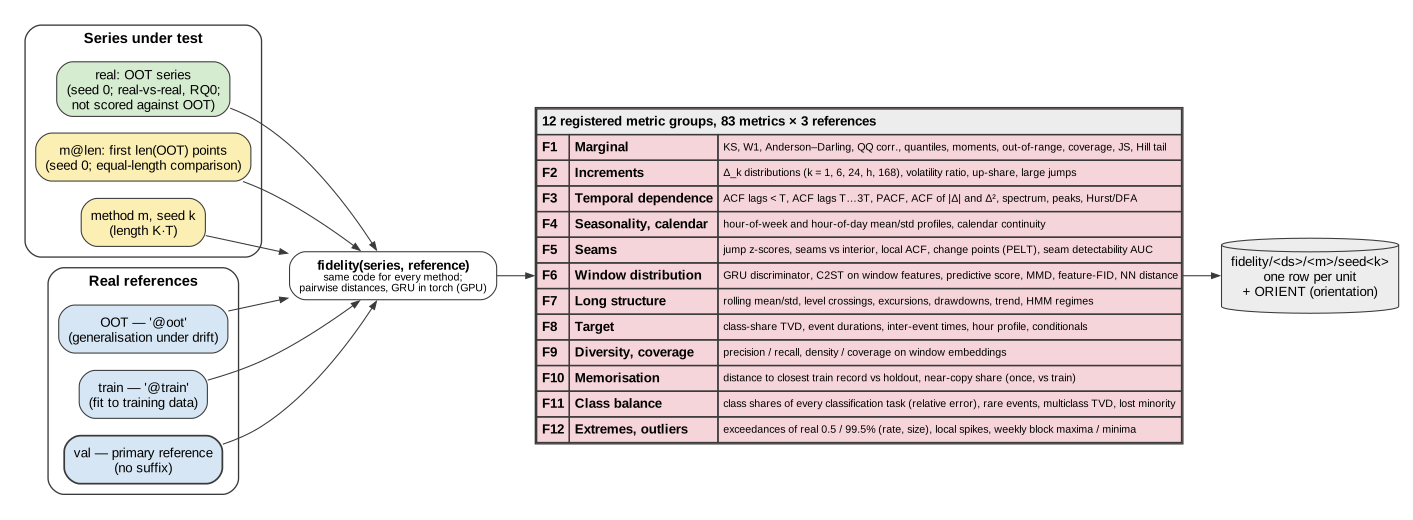
Suggested caption. Fidelity evaluation. Every generated series, the real OOT series (real-versus-real reference), and length-matched truncations of the generated series are scored by the same code against three real references: val (primary), train and OOT. The metrics are organised in 12 groups (83 metrics); memorisation (F10) is computed once, against train.
Inputs
- Series under test: each (method, seed) series of length K·T;
m@len, the first len(OOT) points of each method (seed 0), for an equal-length comparison with the real series;real, the OOT series (seed 0). - References: val (primary, no suffix); train (
@train): how well a method reproduces the data it was fitted on — methods fitted on train, and methods that take reference statistics from train, use this data during fitting; OOT (@oot): generalisation under temporal drift.realis a piece of OOT and is not scored against OOT.
Metric groups
F1 marginal distribution · F2 increments · F3 temporal dependence (incl. ACF beyond the window length, T…3T) · F4 seasonality and calendar · F5 seams · F6 window-level distribution (post-hoc GRU discriminator, C2ST, predictive score, MMD, feature-FID, nearest-neighbour distance) · F7 long-range structure (rolling statistics, level crossings, drawdowns, trend, HMM regimes) · F8 target structure · F9 diversity and coverage · F10 memorisation · F11 class balance over every classification task (relative error of class shares, rare events, multiclass TVD, lost minority class) · F12 extremes and outliers (exceedances of the real 0.5 / 99.5% quantiles, local spikes, weekly block maxima and minima).
Notes for the text
- Each metric has an orientation (
ORIENT, higher or lower is better). - AUC-type scores are reported as |AUC − 0.5|, ratios as |log ratio|; window features are 16 in-house statistics; nearest-neighbour distances are Euclidean.
- Pairwise distances (MMD, nearest neighbours, precision/recall) and the GRU discriminator run in
torch on the GPU. Cross-seed diversity (F9.4) is computed separately at the
collectstage. - Source:
marathonts/bench/fidelity.py,METRICS.md.